

A low price can be appealing, but it tells you very little about what will happen once work begins. Whether you need a repair, cleaning, landscaping or a larger renovation, ask a few focused questions before agreeing to a job. They can help you spot gaps in the scope, prevent unexpected costs and delays, and find out how the professional handles communication and problems. The goal is a clear agreement that both sides understand.
Quick Answer
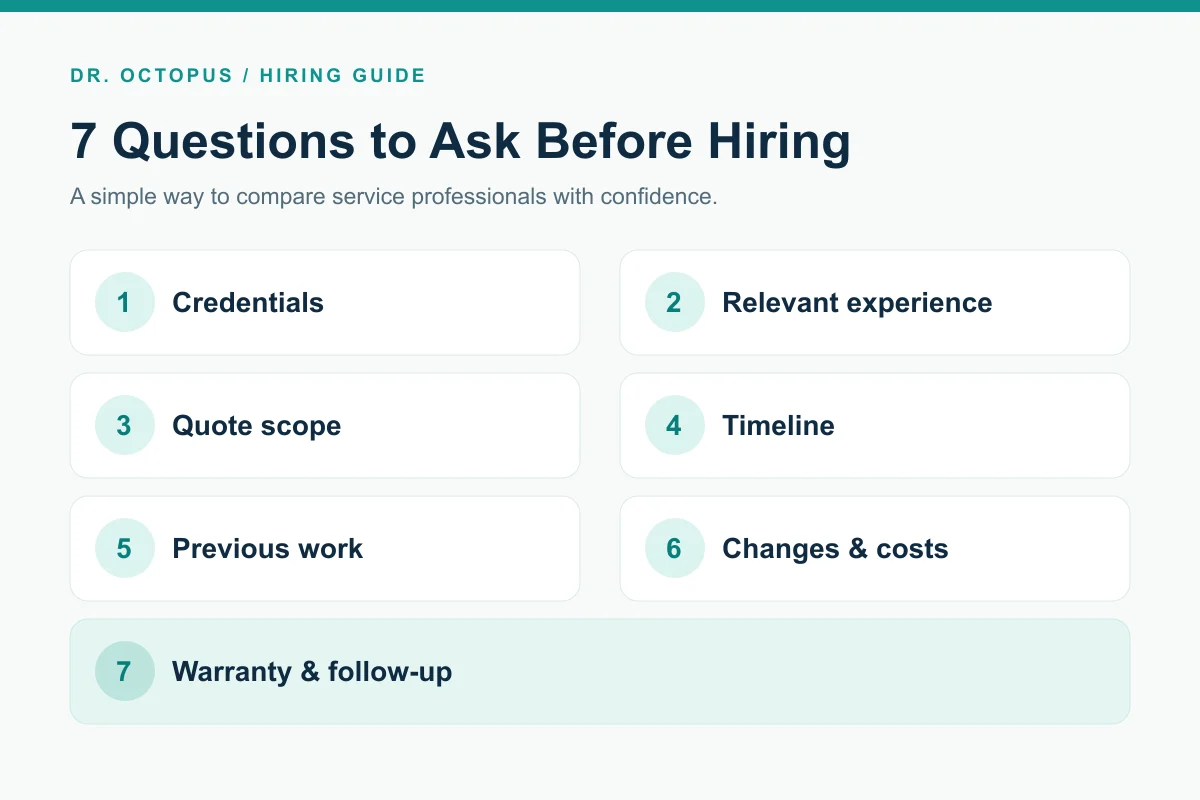
What should you ask before hiring a service professional? Ask these seven questions:
- Are you licensed, insured or certified for this work, where applicable?
- How much experience do you have with this specific type of project?
- What, exactly, is included and excluded from your quote?
- When could you start, and what is a realistic completion timeline?
- Can you show relevant work, reviews or appropriate references?
- How will you approve and document changes, problems and extra costs?
- What warranty or follow-up support do you provide?
Use the answers to compare providers on the same project brief. If an answer is unclear, ask for clarification in writing before you commit.
1. Are You Licensed, Insured, or Certified for This Work?
Ask which credentials apply to your job and how you can verify them. Rules differ by province or territory, municipality and type of service. A general home service provider may have different requirements from an electrician or another regulated trade. Avoid assuming that every contractor needs the same licence—or that a profile badge proves a credential is current.
Describe the exact work and ask who will perform it. Where a licence or certification is required, request the name or number shown on the credential and check it with the issuing authority. Ask what business liability insurance is in place and, for work involving employees or subcontractors, whether any applicable workplace coverage is current. A provider should be able to explain the coverage relevant to your project. For complex work, check permit requirements with your municipality and clarify who will obtain permits and inspections.
2. How Much Experience Do You Have With This Type of Project?
Relevant experience matters more than a broad claim about years in business. Someone may have worked in construction for 15 years but have little experience with the particular repair or material you need. Ask, “Have you completed similar jobs recently?” and “What would your approach be here?”
A useful answer connects your situation to a process: what the provider would inspect, which materials or methods they might use, and what could change the plan. For example, a bathroom renovation quote should account for what can be seen now and what may only become clear after demolition. Ask for examples of comparable work, and notice whether the professional identifies uncertainties instead of promising an effortless result.
3. What Is Included in Your Quote?
A quote is useful only when you know what it covers. Request a written description of the work and compare it against your original request. Look for labour, materials and specifications, applicable taxes, travel or call-out fees, disposal and cleanup, subcontractors, permits and inspections where relevant, and possible additional charges. Ask whether the price is fixed for the stated scope or an estimate that may change, and how long it remains valid.
Two prices may appear far apart because the providers are pricing different jobs. One may include debris removal and quality materials while another leaves those items out. Send the same details and photos to each provider, then compare line by line. If an item is absent, ask whether it is excluded or simply not listed. Clarify payment milestones and what proof of payment you will receive. The cheapest quote is not automatically the best value; a clear, complete quote makes the trade-offs visible.
For larger home projects, put the final scope, schedule and payment terms into a written agreement. The Government of Canada's Office of Consumer Affairs advises comparing quotes prepared from the same specifications and reviewing contract details before work starts.
4. What Is the Expected Timeline?
Ask for a realistic start window and the steps between start and finish. Availability, materials, permits, weather, access to the property and other jobs can all affect scheduling. A precise-sounding promise without a plan is less useful than a range with clear assumptions.
Ask when the provider can start, how long each stage should take, who will be on site and when you will receive progress updates. For a multi-day job, agree on milestones—for example, inspection, materials delivery, installation and final walkthrough. Ask which delays are foreseeable and how you will be told if the schedule moves. If timing is critical, say so before accepting the quote and make any agreed deadline part of the written terms.
5. Can You Provide References or Examples of Previous Work?
Look for evidence related to the service you actually need. Recent reviews, a portfolio, before-and-after photos and completed-project descriptions can help you judge workmanship and communication. A relevant reference may also help, provided the previous customer has agreed to be contacted. Professionals do not need to disclose private customer details to prove their experience.
Read reviews for patterns rather than treating one star rating as a verdict. Do several customers mention punctuality, clean work and clear invoices? Are concerns answered constructively? Look at dates and the type of project behind each review. Ask how the provider would handle a situation similar to any recurring complaint. An impressive photo is helpful, but it should not replace checking the written scope, credentials and terms.
6. How Do You Handle Changes, Problems, or Extra Costs?
Agree on a change process before a surprise appears. A “change order” is simply a written record of work that differs from the original agreement, including its effect on price and timing. It matters when hidden damage is discovered, materials are unavailable or you decide to add something midway through the job.
Ask who will contact you, what evidence you will receive, and whether work pauses until you approve the new scope and cost. A practical rule is: no additional paid work without your approval of the revised description, price and schedule. Keep those approvals with your quote and receipts. Also ask how defects or disagreements will be reported and resolved, and who your single point of contact will be. A good process protects the professional as well as the customer because it prevents different memories of a hallway conversation from becoming a dispute.
If the job involves a renovation, review the consumer guidance for your province or territory. Contract rules vary by location; do not rely on a rule from another province as if it applies everywhere.
7. What Warranty or Follow-Up Support Do You Provide?
Ask what happens after the invoice is paid. Find out whether the provider offers a workmanship warranty, whether materials have a separate manufacturer warranty, what each covers, how long it lasts, and how to request a return visit. Ask about exclusions and whether the warranty depends on maintenance or product registration.
Get any promise in writing with the provider's contact details. A warranty is not the same thing as a guarantee that nothing will ever fail. It should explain the remedy if a covered issue occurs and who pays for parts, labour or travel. Warranty obligations can depend on the service and location, so avoid assuming that a particular warranty applies to every Canadian job.
Bonus: Questions the Professional Should Ask You
Good communication works both ways. A thoughtful provider should want to understand the problem before pricing it. Expect questions such as: What outcome do you want? When do you need the work done? What budget range do you have? Are there access, parking or building rules? Have earlier repairs been attempted? Can you provide photos or measurements?
If the provider asks to inspect the site for a complex job, that can be a sign they are trying to quote accurately. Share the same facts with each candidate so their answers are comparable. Flag anything you do not know; a professional can then explain how they would investigate it.
Red Flags to Watch for Before Hiring
Be cautious if someone refuses to describe the scope or provide a clear written quote; pressures you to decide immediately; requests an unusual payment arrangement without an explanation or receipt; avoids basic questions about credentials or timing; changes key details between conversations; or communicates poorly before the job begins. One awkward message does not prove a provider is unreliable, but a pattern of evasive answers is a reason to slow down and verify.
Why You Should Compare More Than One Quote
Several comparable quotes reveal more than a price range. They show differences in materials, scope, availability, assumptions and communication. For a substantial renovation, Canada's Office of Consumer Affairs suggests meeting at least three potential contractors where practical. For smaller or urgent services, the useful number may be different. Give providers the same brief, then compare what each is promising and what remains uncertain. Choose the option that best fits the work, your priorities and your comfort with the agreement—not simply the lowest number.
Service Professional Hiring Checklist
Before hiring:
- [ ] Confirm the scope of work.
- [ ] Check experience with similar jobs.
- [ ] Verify applicable licences, certifications and insurance.
- [ ] Request a written quote with inclusions and exclusions.
- [ ] Understand the start date, milestones and likely delays.
- [ ] Review relevant work and customer feedback.
- [ ] Agree on how extra costs and changes are approved.
- [ ] Understand any warranty and follow-up process.
- [ ] Compare more than one provider when practical.
- [ ] Keep important agreements, approvals and receipts in writing.
How Dr. Octopus Makes Comparing Service Professionals Easier
Dr. Octopus gives customers a place to browse local businesses, review business profiles and explore service categories. Customers with an account can post a service request, describe the job and compare responses from relevant providers before deciding. Use those tools to build a shortlist and ask the seven questions above. You are still responsible for checking credentials, insurance, references and final contract terms for the specific job.
Make the Decision With the Full Picture
The best professional is not necessarily the cheapest one. A stronger decision comes from a shared scope, relevant experience, clear written pricing, a realistic timeline and a plan for changes and follow-up. Ask the questions, compare answers and make sure you understand the agreement before work starts.