

Hiring a contractor requires trust before work begins. A homeowner may have only a profile, conversations, a quote, reviews and a schedule to judge. None alone proves the outcome. To learn how to find a reliable contractor, look for consistent signals, verify important claims and compare the same scope across providers.
Quick Answer: How Can You Tell If a Contractor Is Reliable?
Look for clear communication, relevant experience, consistent business details and a written quote that explains scope, timing, materials, exclusions and possible extra costs. Ask who will do the work, request appropriate documentation and notice whether questions receive direct answers without pressure. These are general indicators, not guarantees. Verify trade-specific requirements with the appropriate local authority before hiring.
1. Start by Checking the Contractor's Business Information
Compare the business name, contact details, website or company profile, service area and stated specialty. If they claim years in business, ask how that history can be confirmed. Details should be reasonably consistent across a quote, correspondence and public profile. A basic website or polished logo can be helpful for contact, but neither proves workmanship or credentials. Start with the guide to finding local professionals if you need a broader search process.
2. Look for Relevant Experience, Not Just Years in Business
Years of unrelated work may tell you less than recent experience with your job. Ask about similar projects, complications and who handled them. For a renovation, distinguish design, demolition, electrical, plumbing and finishing responsibilities. A service professional should explain when another specialist is needed. Experience is evidence, not a promise.
3. Review Previous Work
Ask for completed-project photos or a case study close to your project in size and complexity. Look across several examples, not one striking after-photo. Ask what work the business performed and whether the example is recent. A curated gallery cannot show every delay or follow-up issue. If practical, request recent references and permission to contact them.
4. Read Reviews Carefully
Read beyond star ratings. Patterns about communication, timeliness, cleanup, workmanship and problem resolution matter more than one score. A few negative reviews do not automatically indicate unreliability; context and the business's response matter. Look across sources and avoid treating anonymous comments as verified fact. Our seven questions before hiring help test what reviews suggest.
5. Pay Attention to How They Communicate
Before hiring, notice whether the provider answers basic questions, acknowledges uncertainty and confirms important decisions in writing. Response times can vary with workload, but a realistic update is more useful than silence. Repeatedly changing answers, refusing to explain a quote or disappearing without explanation may warrant closer review. Ask who will be your regular contact and how urgent issues will be reported during the job.
6. Ask for a Clear Written Quote
A useful quote describes the work, labour and materials, proposed timing, exclusions, applicable taxes, payment terms and assumptions behind the price. Depending on the job, it can also address possible additional costs and follow-up or warranty terms. Not every item is legally mandatory in every situation. The point is to understand what you are comparing before accepting a price. The local service quote guide explains how to put competing offers side by side. Canada's Office of Consumer Affairs recommends giving providers the same specifications when requesting renovation estimates.
7. Understand What Is Not Included
Exclusions can matter as much as the work listed. Ask plainly: “What is not included in this quote?” Discuss disposal, permits, materials, painting, cleanup, hidden repairs and subcontracted work where relevant. If a bathroom quote excludes repairing unseen water damage, ask how that possibility would be assessed and priced. Do not assume a task is included because it seems necessary to finish the project. Record the answer alongside the scope so a later comparison is fair.
8. Check Licensing, Certification, and Insurance Where Applicable
Requirements vary by trade, project and province, territory or municipality. Electrical, gas, plumbing and construction work can have different rules, so ask what credentials and insurance are appropriate for this job, then verify with the relevant authority or insurer rather than relying on a profile badge. For example, Québec's contractor guidance points readers to the RBQ register for applicable work; it is not a national licensing rule. Check with your municipality about permits and agree in writing who will arrange them. The electrician hiring guide discusses trade-specific questions without assuming one national standard.
9. Ask Who Will Actually Perform the Work
The person preparing the quote may not be on site. Ask who will attend, whether employees or subcontractors are involved, who supervises them and whom to contact when a problem arises. Subcontracting is common and is not itself a warning sign. Clear responsibility for scheduling, payment, permits where needed and quality follow-up matters more than the staffing model. For larger projects, put these responsibilities in the written agreement.
10. Look for Realistic Timelines
Ask for an expected start date, duration, key stages and dependencies such as materials, permits or inspections. A provider who can start tomorrow may simply have availability; a long wait may reflect demand. Neither proves quality. The useful question is whether the schedule fits the scope and whether likely delays will be communicated. Confirm which dates are estimates and how changes will be handled.
11. Understand the Payment Structure Before Work Begins
Before agreeing, ask about any deposit, progress milestones, final payment, accepted payment methods and documentation for payments. Deposits and consumer protections vary by jurisdiction and contract type; this guide does not set a universal limit. Unclear expectations or pressure to pay the entire amount without an explanation deserve more questions. Keep a copy of the written terms and receipts, and check local consumer guidance for your particular work.
12. Ask How Changes Will Be Handled
A change order is an agreed update to the original scope, price or schedule. Ask what happens when hidden damage or a new request changes the plan: who describes the new work, who prices it, who approves it and where that approval is recorded. For substantial renovation work, the Office of Consumer Affairs recommends clearly amending the agreement for added jobs. Compare revised quotes against the original scope before authorizing extra work.
Reliable Contractor vs Red Flags
The following are general indicators, not proof of future performance. A single concern calls for a question; a pattern may justify looking elsewhere.
| Reliable Signal | Potential Red Flag |
|---|---|
| Clear quote | Vague pricing |
| Consistent business information | Conflicting information |
| Realistic timeline | Unrealistic promises |
| Written scope | Unclear scope |
| Direct answers | Avoids basic questions |
| Transparent changes | Unexplained extra costs |
| Professional communication | High-pressure tactics |
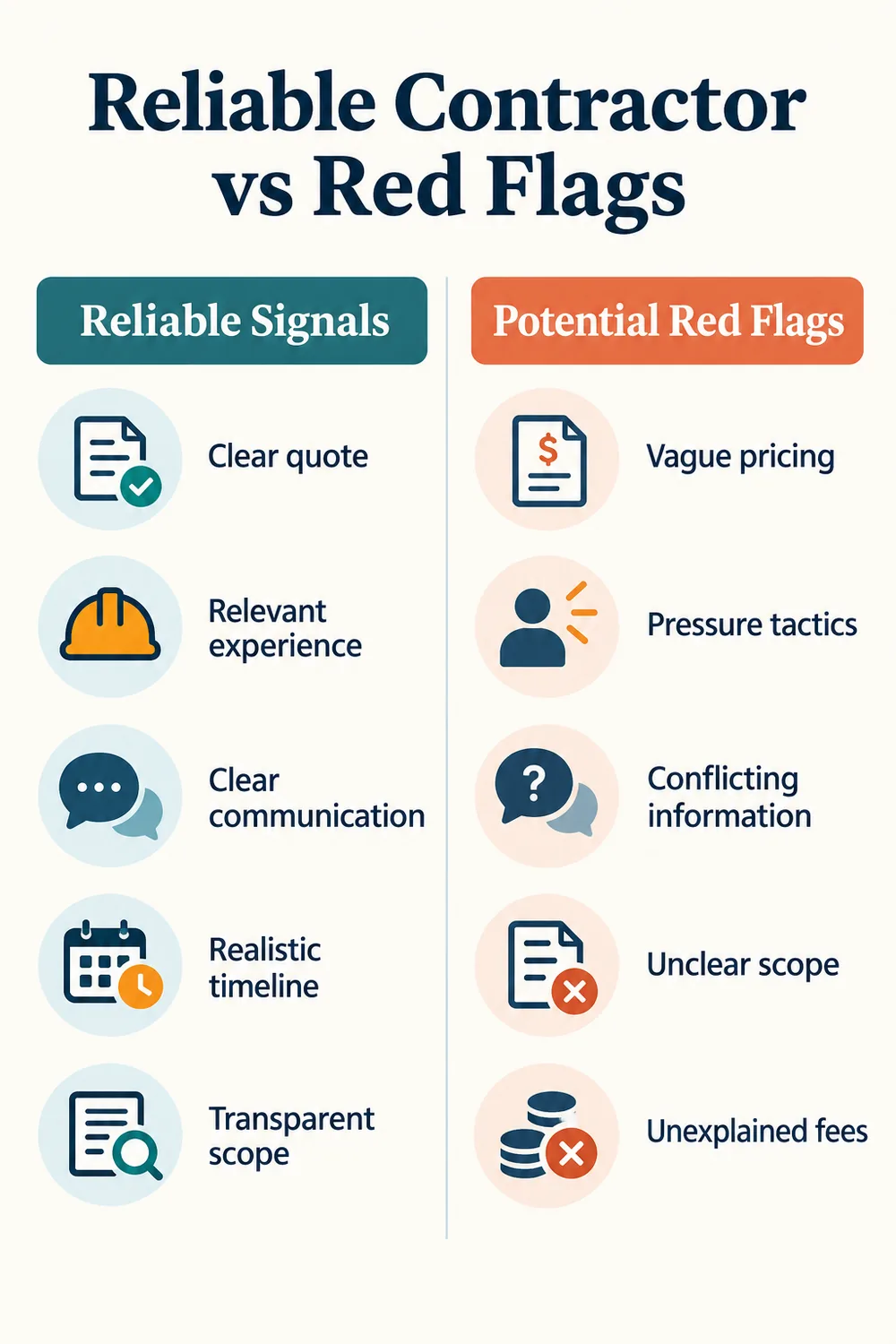
Contractor Red Flags to Watch For
An unwillingness to define scope, refusal to answer reasonable questions, large unexplained price changes or pressure to decide immediately may warrant further review. So can conflicting business information, an unusually vague quote, a request to bypass a permit where one is required, no clear point of contact or a major difference between spoken and written terms. Ask for clarification and documentation before drawing a conclusion. These observations do not establish misconduct by any individual business.
Questions to Ask Before Hiring a Contractor
- Have you completed projects similar to mine?
- Who will perform and supervise the work?
- What exactly is included in your quote?
- What is excluded?
- What start date and duration do you expect?
- What could change the price?
- Are permits required for this project here?
- Who would arrange any required permits and inspections?
- What insurance is appropriate, and how can I confirm it?
- How will changes be proposed and approved?
- What follow-up or warranty, if any, is offered?
- What payment schedule and methods do you use?
Contractor Hiring Checklist
- [ ] Verify basic business information.
- [ ] Check relevant experience and previous work.
- [ ] Read reviews carefully and ask for references where useful.
- [ ] Ask clear questions and get a written quote.
- [ ] Understand exclusions and possible extras.
- [ ] Check credentials and insurance where applicable.
- [ ] Confirm who will do the work and when.
- [ ] Understand payment terms and how changes are approved.
- [ ] Compare providers on the same scope.

Should You Compare Multiple Contractors?
For non-urgent, complex or higher-value work, comparing more than one provider can reveal differences in scope, materials, timing, experience and communication. There is no magic number for every service call. Give each provider the same description, then ask about differences instead of comparing totals alone. The federal home-renovation guidance suggests meeting several candidates for renovations. See how Dr. Octopus helps compare local service quotes for a practical comparison method.
Why the Cheapest Contractor Is Not Always the Best Choice
A lower price can be legitimate. It may reflect a simpler method, different materials, lower overhead, a shorter scope or a different schedule. Equally, a higher price does not guarantee better work. Ask each contractor to explain assumptions, exclusions and potential extras; then compare the total offer against your priorities. If a price differs sharply, first check whether everyone understood the same job. The plumber cost guide illustrates why service estimates can vary by scope and location.
How Dr. Octopus Can Help You Compare Local Contractors
You can post a service request, describe the job and review responses from businesses that choose to respond. Compare any available quotes with company information, ask follow-up questions and choose the provider you prefer. You can also browse companies, explore service categories or see how the marketplace works. Response volume and provider availability vary; Dr. Octopus does not guarantee price, workmanship, licence status or insurance. If the job is seasonal, the Canadian winter maintenance checklist may help you define the request first.