

Receiving one service quote tells you what one business would charge. Receiving several gives you context. Two Canadian contractors may price the same request differently because their scope, materials, labour assumptions, schedule, warranty or service level differ. The useful question is not simply “Which number is lowest?” It is “What would I receive for that number, and what could change it?”
Quick Answer: Why Should You Get Multiple Quotes?
Multiple service quotes can help you understand a likely price range, compare the work included, spot missing items and possible extra costs, assess timing and communication, and ask better questions. Comparing offers on the same project description makes it easier to choose overall value. It may save money, but neither a lower price nor a better outcome is guaranteed.
One Quote Gives You a Price — Multiple Quotes Give You Context
One estimate cannot show whether a price is typical for your job or whether work is missing. Another provider may propose a different method. Ask why. Canada's Office of Consumer Affairs recommends the same specifications when comparing renovation estimates.
How Multiple Quotes Can Help You Understand Pricing
Labour, materials, equipment, accessibility, subcontractors, overhead, location, complexity and scheduling affect pricing. Illustrative example only, not Canadian market averages: Quote A is $2,900, Quote B is $3,400 and Quote C is $4,100. If B includes disposal and finishing while A excludes both, the $500 gap says little about final cost. Ask why the prices differ.
1. Multiple Quotes Help Reveal the Real Scope of the Job
One provider may include preparation, cleanup, disposal and finishing; another may price only the repair. Compare line items. If one recommends additional work, ask why and whether it can be priced separately. Our questions before hiring a service professional help clarify responsibilities.
2. You Can Identify Missing Costs Earlier
Depending on the project, materials, travel, equipment rental, disposal, applicable permits, taxes, subcontractors and cleanup may be included, excluded or unnecessary. Ask, “Is anything likely to be charged separately?” Also ask how unforeseen work would be approved and priced. Written answers make a quote easier to evaluate; they cannot eliminate every later surprise.
3. You Can Compare Materials and Quality Levels
Product brand, grade and specification can change the price. Ask whether materials are equivalent, who supplies them and what substitutions are allowed. Premium is not automatically best; a lower-cost material may fit. Know the trade-off.

4. Multiple Quotes Help You Compare Timelines
A lower quote may mean a later start or longer job; a higher one may reflect urgent availability. Neither is inherently better. Compare expected start, duration and dependencies such as delivery or inspections. Dates can change.
5. Quotes Help You Evaluate Communication Before Hiring
Did the business explain assumptions and answer reasonable questions? Is its quote understandable? These clues help compare working styles. A fast response alone does not establish workmanship. Look for clarity and follow-through.
6. Multiple Quotes Can Help You Spot Unusual Pricing
An offer far above or below the others warrants questions, not accusations. It could reflect extra work, materials, scheduling or an omission. Recheck that each provider received the same facts. Unexplained differences add uncertainty.
7. Comparing Quotes Can Prevent False Savings
The lowest upfront price may not be the lowest total cost if preparation, disposal or finishing comes later. A higher quote may include things you do not need. Compare the same finished result, including likely extras.
How Many Quotes Should You Get?
For many non-emergency or higher-value jobs, two or more written quotes provide useful context. Three is a common practical approach; Canada's Office of Consumer Affairs suggests meeting at least three potential contractors for renovations. That is advice for that setting, not a universal legal rule. Urgency, complexity, provider availability and the value of the work affect how many comparisons are worthwhile. See our step-by-step quote comparison guide once the offers arrive.
When You May Not Need Multiple Quotes
Collecting offers takes time. A small low-cost task, an urgent safety repair, warranty work, an existing trusted provider or a rare specialist may make further quotes impractical. In an emergency, first address immediate safety and ask about scope and charges as clearly as circumstances allow. The goal is an informed decision, not an arbitrary quote count.
Why the Cheapest Quote Is Not Always the Best Quote
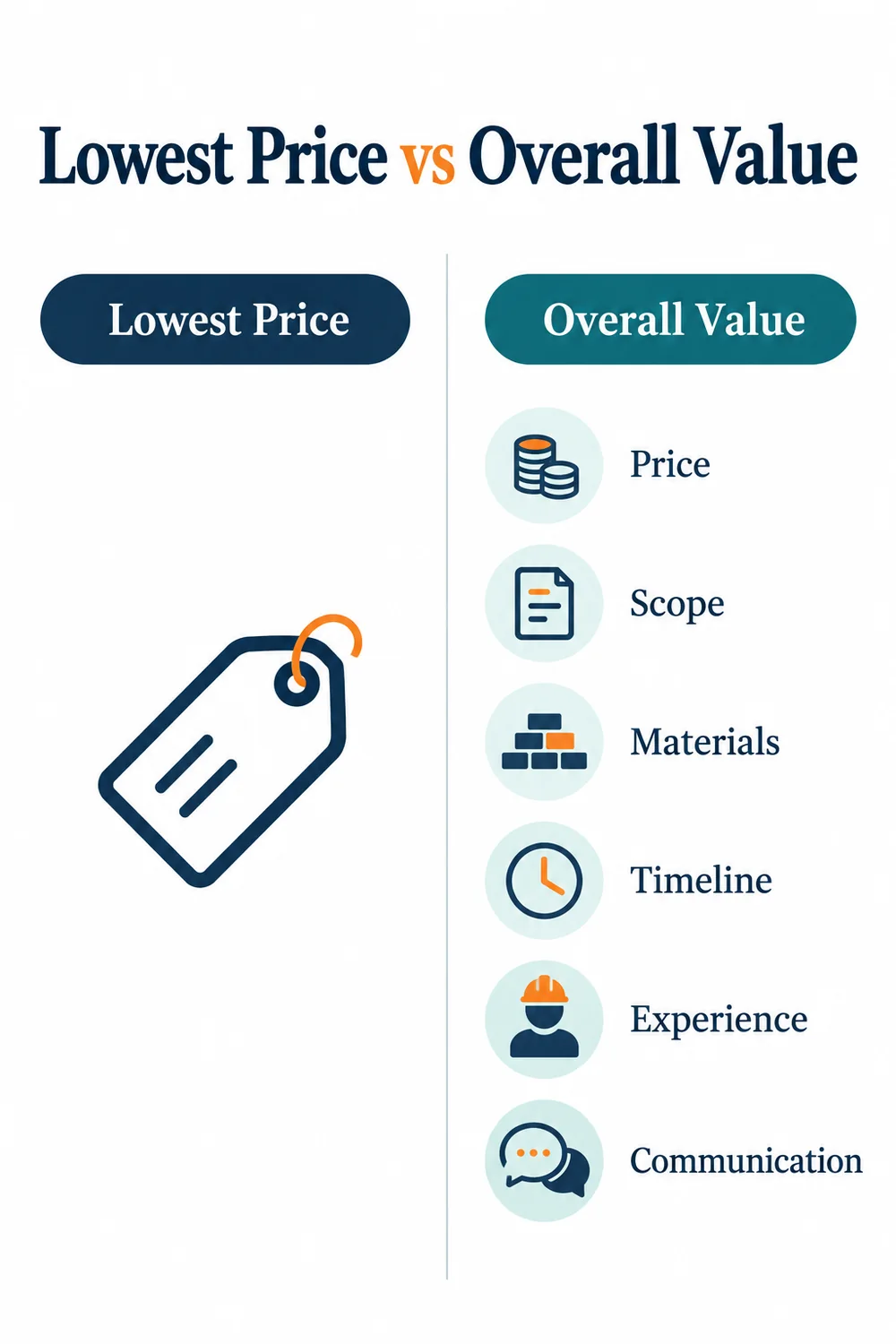
Compare scope, materials, experience with similar work, timing, exclusions, warranty or follow-up and communication. If the lowest offer meets your needs and its terms are clear, choosing it may be reasonable. If it omits important work, its apparent saving may disappear. Price belongs in context; our guide to finding a reliable contractor covers the provider checks behind the number.
Why the Most Expensive Quote Is Not Automatically Better Either
A higher figure may include more work, premium materials, specialized expertise or higher overhead. None of those automatically proves superior quality or a better fit. Ask what the difference buys you, and whether you actually want it. A quote should earn its place through relevant scope and clear terms, not its price alone.
How to Compare Quotes Fairly
- Give each provider the same project description, photos and access details.
- Align the proposed scope and finished result.
- Compare material specifications and who supplies them.
- Check labour assumptions and whether pricing is fixed or an estimate.
- Compare start dates and expected duration.
- Mark exclusions in each offer.
- Read warranty and follow-up terms, if any.
- Ask how additional work and costs are approved.
- Review relevant provider experience and information.
- Choose the offer that best fits your priorities and budget.
For a deeper worksheet and follow-up process, use our guide to comparing local service quotes.
Example Service Quote Comparison
Use this blank framework for actual offers; A, B and C are placeholders, not businesses or advertised prices.
| Factor | Quote A | Quote B | Quote C |
|---|---|---|---|
| Total price | Enter amount | Enter amount | Enter amount |
| Scope | List included work | List included work | List included work |
| Materials | Record specifications | Record specifications | Record specifications |
| Timeline | Start and duration | Start and duration | Start and duration |
| Possible extras | Note conditions | Note conditions | Note conditions |
| Warranty | Note terms, if any | Note terms, if any | Note terms, if any |
| Experience | Similar work to check | Similar work to check | Similar work to check |
| Availability | Confirm date | Confirm date | Confirm date |
Questions to Ask When Quotes Are Very Different
Are the providers pricing the same scope and materials? Is cleanup included? Who handles permits where applicable? Are taxes included? Could equipment, travel or hidden work cost extra? Does one offer a different timeline or include extra work? Are follow-up or warranty terms different? Ask for a revised written breakdown where the answer changes the comparison.
Common Mistakes When Comparing Quotes
- Looking only at the total price.
- Comparing different scopes as if they were identical.
- Ignoring exclusions or vague wording.
- Assuming materials are equivalent.
- Overlooking start date and duration.
- Forgetting to ask about potential extra charges.
- Leaving important answers verbal and unrecorded.
- Treating a quote as proof of credentials or project quality.
Multiple Quote Checklist
- [ ] Each provider understands the same job.
- [ ] Total price and pricing basis are clear.
- [ ] Scope and materials are comparable.
- [ ] Start dates and duration fit my needs.
- [ ] Exclusions and possible extras are recorded.
- [ ] Warranty or follow-up terms are understood.
- [ ] Relevant experience and business details are reviewed.
- [ ] Communication has been clear.
- [ ] Major price differences are explained.
- [ ] I am choosing for overall value, not price alone.
Can Comparing Quotes Really Save You Money?
It can help you identify an option priced above comparable alternatives, expose a missing task that might otherwise become an extra charge, or select a better match between price and scope. It can also reveal that a seemingly cheaper offer is simply a smaller job. There is no reliable universal savings percentage, and comparison cannot guarantee a lower final bill.
How Dr. Octopus Makes Quote Comparison Easier
You can post a service request, describe the work and review available responses from relevant businesses. Compare the offers and business information, ask questions and decide which provider fits your project. Response counts and availability vary. Dr. Octopus does not choose for you or guarantee savings, qualifications, insurance or a particular result. You should verify requirements relevant to your location and job. Start with our local professional search guide.
Better Requests Can Lead to Better Quotes
State the problem, location, approximate dimensions, preferred timing and expected result. Add photos when useful and describe known access issues or damage. Clear information helps businesses respond to the same job and helps you compare their assumptions. For specialized work, read our electrician hiring guide or Canadian plumbing cost guide for questions specific to those services.