

A customer may trust your work and still hesitate if the quote leaves them guessing. Does the price include disposal? Who buys the fixtures? When could the work start?
Learning how to write a professional quote means answering those questions before they become another phone call. A clear professional quotation explains the work, cost, inclusions, exclusions, timing and next step. It can improve your chances of winning suitable projects; it cannot guarantee a yes.
Quick Answer: What Should a Professional Service Quote Include?
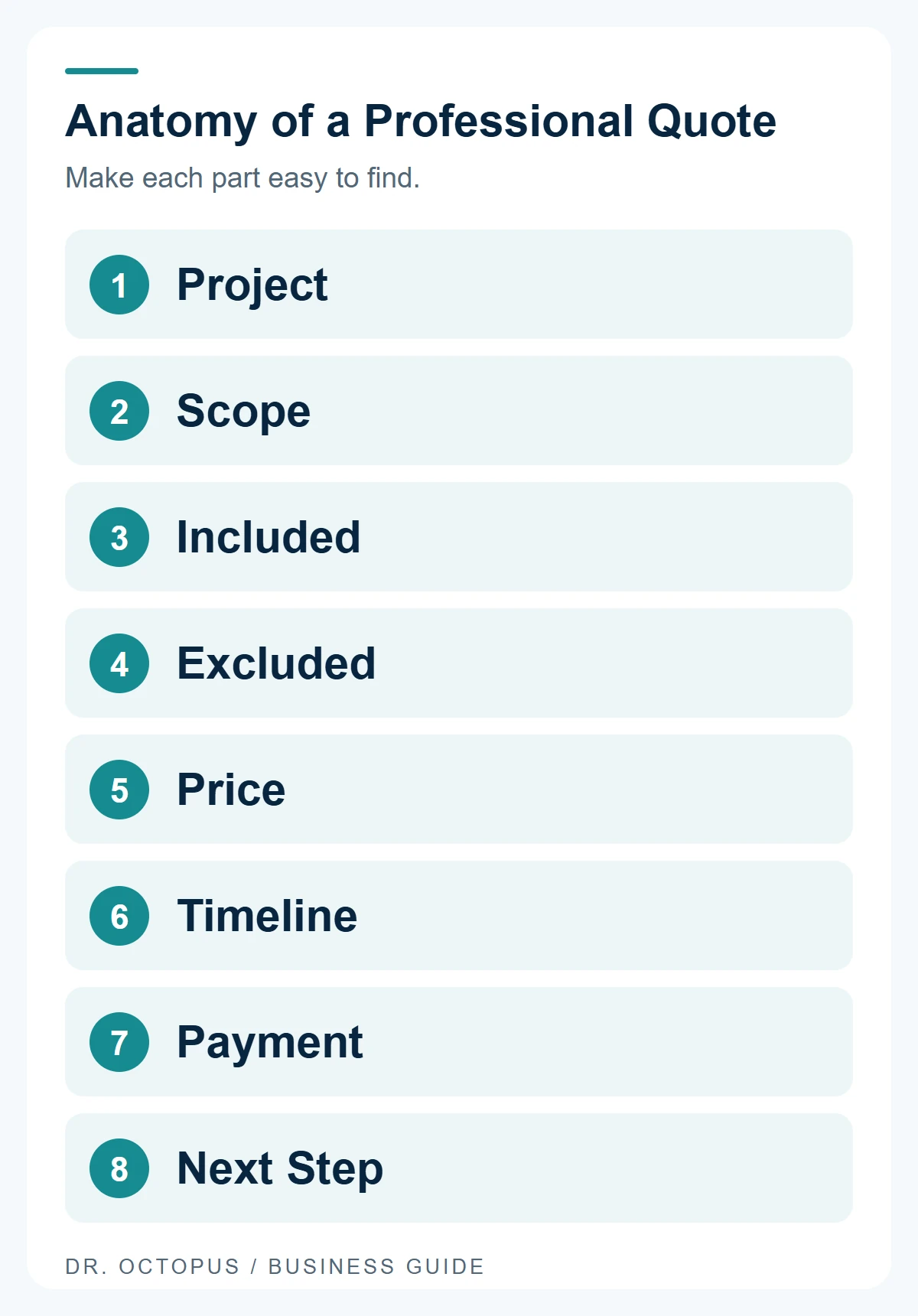
A professional service quote should include:
- Customer and project details
- A clear scope of work
- Price, currency and applicable tax treatment
- Materials or allowances, where relevant
- Expected timeline
- Inclusions
- Exclusions
- Payment terms
- A validity period, where appropriate
- An acceptance method and next step
Exact requirements vary by business, service type and jurisdiction.
A Quote Is Not Just a Price
“Kitchen renovation: $18,500” tells a customer almost nothing. Illustrative example only, not market pricing. Explain which cabinets, surfaces, installation and finishing that amount covers. A number without scope invites customers to fill the gaps with assumptions.
1. Start With the Customer’s Actual Request
Confirm the service, address, project size, desired result and preferred timing. Ask about access and special conditions: “Is there anything about the project that could affect access, timing or materials?”
For a mover, stairs, elevator bookings and parking can change the job. For a cleaner, an occupied home differs from an empty one. Resolve those details before quoting.
2. Use a Clear Quote Title
Illustrative titles: “Bathroom Renovation — 24 King Street,” “Move-Out Cleaning — Two Bedroom Condo,” or “Electrical Panel Upgrade.” These are more useful than “Quote 1043.” Keep a reference number too, so both sides can identify the right version later.
3. Write the Scope Like Someone Else Has to Understand It
“Complete bathroom work” could mean very different things to you and the homeowner. Name the actions and the boundaries.
An illustrative vanity scope might say: remove the existing vanity; install the specified replacement and faucet; fit the customer-supplied mirror; reconnect plumbing; remove debris from this work. State who supplies each item and identify any finishing work separately.
Read the scope as if another crew had to follow it. Could they tell what to do without calling you? Could the customer tell what they are buying? If either answer is no, revise the wording.
Scope Example — Weak vs Strong
Weak: “Full kitchen renovation.”
Stronger: “Remove existing lower cabinets and countertop, install client-selected cabinetry and countertop, reconnect the sink, and complete the finishing work listed below.”
This is an illustrative scope excerpt, not a complete renovation contract. The selections and finishing list still need detail.
4. Separate Labour, Materials and Optional Work When Useful
Some contractor quotes benefit from separate labour, materials, equipment and allowances. A straightforward service may be clearer with a flat project price. You do not need to expose every internal cost.
Separate optional upgrades from the base offer. Show whether the total includes them; never make the customer calculate that from scattered notes.
5. Explain Allowances Clearly
An allowance is an amount set aside for something not yet selected. Illustrative example only: a $600 tile allowance covers the specified tile purchase, excluding installation. Explain how a selection above or below that amount affects the total and how you will confirm the adjustment before ordering.
6. Make Inclusions Obvious
List what comes with the price. Depending on the job, this might be labour, specified materials, delivery, standard cleanup and removal of named items. “Cleanup included” deserves a boundary: removing your job debris does not necessarily mean cleaning the entire property.
7. Make Exclusions Just as Clear
Possible exclusions include painting, permit fees, appliance purchases, structural repairs or concealed damage. Use only exclusions that actually apply, and discuss any work needed for a usable result. This section sets expectations; it should not hide foreseeable work or evade responsibilities.
8. Explain What Could Change the Price
Replace “price may change at any time” with specific triggers: additional work, changed selections, hidden site conditions, extra travel or labour caused by an agreed scope change. Explain that you will document the proposed work, price and timing for customer approval before proceeding.
9. Set a Realistic Timeline
Give the expected start window and estimated duration. Identify dependencies such as material delivery, customer selections, site access or other trades. Distinguish a proposed schedule from a confirmed booking. An honest window is more useful than an exact completion date you cannot control.
10. Be Clear About Payment Terms
Set out any deposit, milestone payments, final payment, due dates and accepted methods. Make clear whether amounts include applicable taxes. Check the rules relevant to your province, trade and agreement before setting payment terms. For renovation work, the Office of Consumer Affairs guide points readers toward their local consumer office for requirements.
11. Add a Quote Validity Period When Appropriate
Material and labour costs can change. “Valid for 30 days” is an illustrative example only, not a universal recommendation. Choose a period you can support and explain that an expired quote needs reconfirmation before acceptance.
12. Make the Next Step Obvious
For quote acceptance on a directly issued customer quote, you might write: “To proceed, reply to confirm acceptance. We’ll then confirm scheduling and next steps.” Give a contact for questions and explain when booking begins. Use the actual quote acceptance process for the channel where you sent it.
The Quote Should Be Easy to Scan on a Phone
Open your pricing proposal on your own phone. Can you find the total, scope and acceptance instructions without zooming? Use short sections, readable text and a visible next step. Avoid wide tables, dense paragraphs and complicated PDFs with crucial conditions buried at the bottom.
What Makes Customers Ignore a Quote?
A late reply, unexplained price, vague timeline or missing phone number can make a decision harder. Obvious errors and a wall of text add friction. These do not prove why someone declined: they may have postponed the project. Ask when appropriate instead of guessing.
Common Quote Mistakes
- Sending only a price
- Leaving a generic quote template unedited
- Omitting exclusions
- Using vague scope language
- Forgetting the project location
- Mixing optional costs into the total
- Leaving typographical errors
- Overpromising the timeline
- Providing no next step
- Skipping a reasonable follow-up
Do Not Try to Win Every Job by Being the Cheapest
Repeated discounts can shrink your margin and create expectations you cannot sustain. Explain what the price buys before changing it. Sometimes a lower price fits a smaller scope; sometimes the project is simply a poor fit. Clear service pricing matters more than reflexively charging more or less.
A Strong Quote Helps Customers Compare Fairly
Help customers compare scope, materials, timelines, exclusions and business information alongside totals. Our guides to comparing local service quotes on Dr. Octopus and getting multiple quotes explain the customer’s side. A cheaper total may cover less work; make the differences easy to check.
Example Professional Quote Structure
Adapt this general quote template to the job. This professional quotation format is not legal advice or a universal contractual form.
- Quote details: Customer: [Name]; Project: [Title]; Location: [Address]; Date/reference: [Details]
- Scope of work: [Actions, quantities, specifications and responsibilities]
- Included: [Included items and services]
- Not included: [Relevant exclusions]
- Project price: CAD $[Amount]; [applicable taxes and total]
- Optional work: [Separate items, prices and selection method]
- Estimated timeline: [Start window, duration and dependencies]
- Payment terms: [Amounts, triggers, due dates and methods]
- Quote valid until: [Date, if appropriate]
- Next step: [Acceptance instructions and scheduling process]
- Business contact: [Company, contact person, phone and email]
Quote Example — Cleaning Business
Illustrative scope: Move-Out Cleaning — Two Bedroom Condo. Include the kitchen, two bathrooms, floors, empty interior cabinets and appliance exteriors. Price inside-oven and inside-refrigerator cleaning separately as optional work. Confirm access, water availability and whether belongings will be removed. No market price is implied.
Quote Example — Contractor
Illustrative scope: Replace Entry Door. Remove the existing door, install the agreed door and hardware, complete listed trim work and remove installation debris. Identify who supplies the door. State whether painting and repairs to concealed framing are excluded. This is a scope example, not contract language.
How to Follow Up Without Annoying the Customer
Base your quote follow-up on the customer’s decision timeline. Try: “Hi Sam, just checking that you received the bathroom quote. Happy to clarify anything before you decide.”
A later message may be reasonable if clarification would help. Respect a decline or request for space. Avoid daily reminders, repeated calls, pressure and invented deadlines.
If the Customer Says Your Quote Is Too Expensive
Ask: “Is the total outside the budget, or is there a particular part of the scope you’d like us to review?” Then consider suitable changes: remove optional items, adjust materials, reduce scope or phase the work. Show the revised scope and price together rather than quietly cutting necessary work.
When a Customer Compares You With a Cheaper Quote
Stay factual. Are both offers covering the same work? Are materials comparable? Do exclusions or timelines differ? Explain your own offer without criticizing a competitor. If the scope is equivalent, the customer may still choose differently.
Track Why Quotes Are Won or Lost
Use a simple sheet with: Customer, Service, Quote Amount, Date Sent, Won/Lost, Reason and Follow-Up Done? Record stated reasons such as price, timing, another provider or postponement. Keep “no response” separate from an assumed objection. Review a growing set for patterns; there is no promised conversion benchmark.
A 10-Minute Quote Quality Check
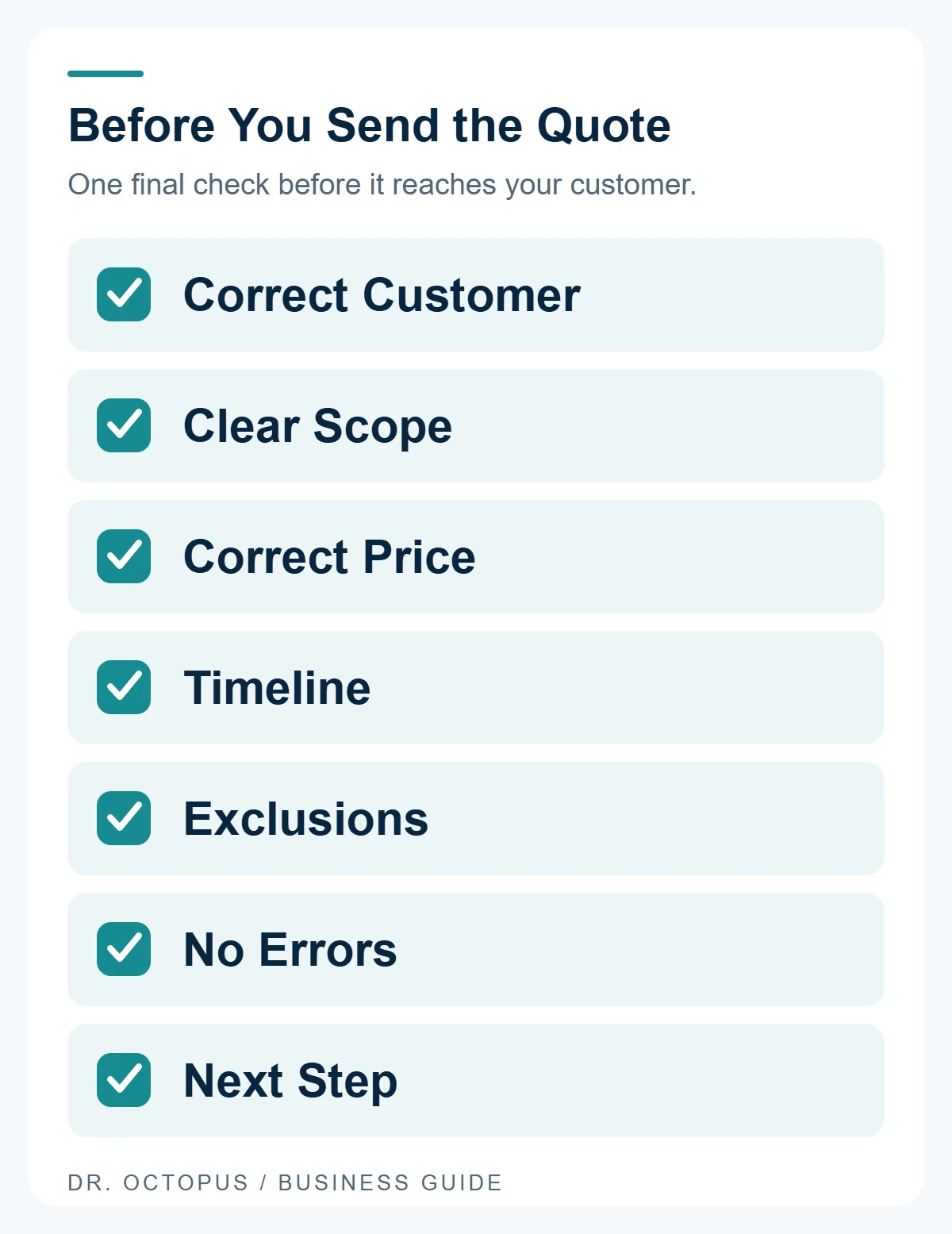
- ☐ Customer, project and location are correct
- ☐ Scope is understandable
- ☐ Price and arithmetic are correct
- ☐ Inclusions are listed
- ☐ Exclusions are listed
- ☐ Optional items are separate
- ☐ Timeline is realistic
- ☐ Payment terms are clear
- ☐ Spelling is checked
- ☐ Next step is obvious
- ☐ Contact details are correct
How Quotes Work on Dr. Octopus
Signed-in businesses can submit one proposal per relevant open request they do not own. The quote form asks for a CAD price, estimated completion time, proposal description and an optional supporting document. Explain scope, inclusions, exclusions, materials, options and payment terms in the description or attachment; use these spaces for the detail that does not have its own form field. The request owner reviews quotes in their dashboard and can accept one. Other quotes then become “Not selected.” The site creates dashboard notifications and queues email alerts for matching opportunities and new quotes; check your dashboard for updates rather than relying on an inbox alert.
Support your quote with a clear business profile and credible information about your work. Our guides to getting more local customers online and customer reviews cover those supporting pieces.
New here? Join as a Business by choosing the Business registration option. See How It Works for an overview, and keep the services shown in the Companies Directory aligned with what you quote.